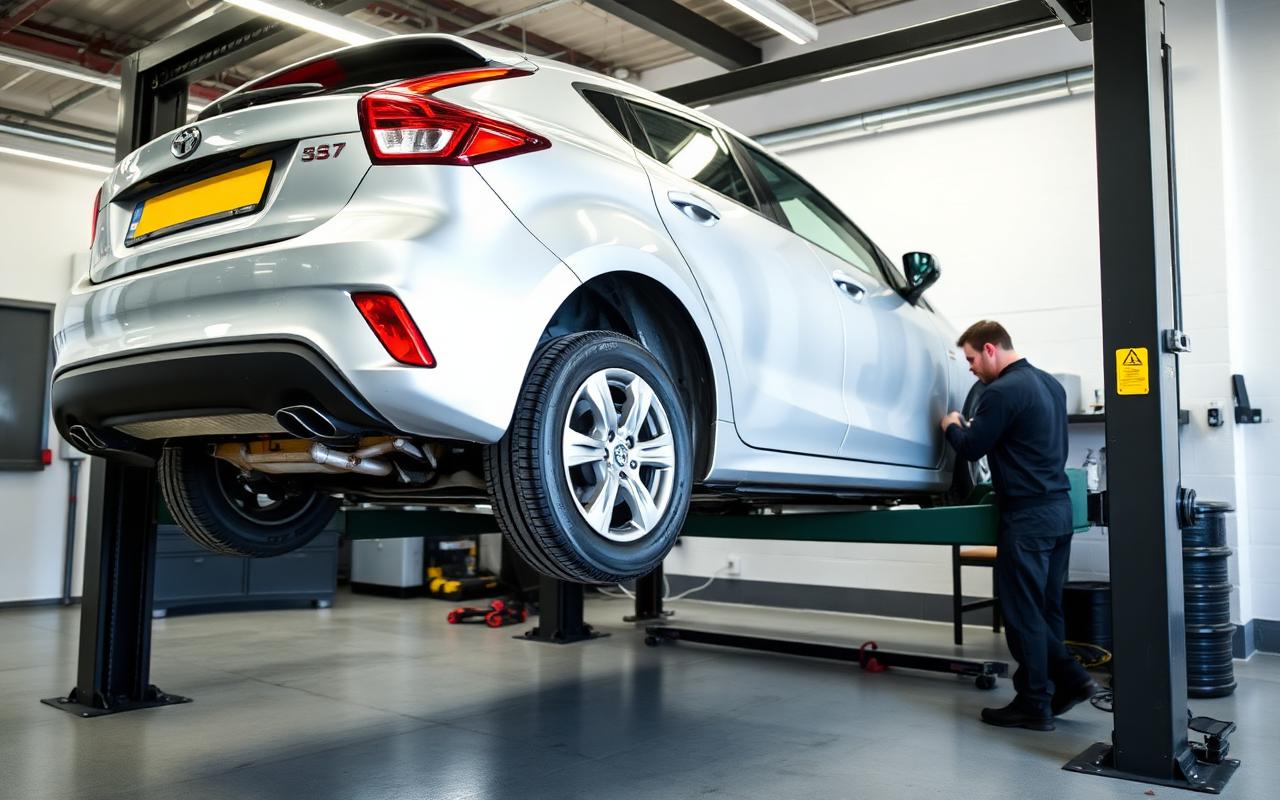
Wheel alignment, sometimes called tracking, refers to adjusting the angles at which a vehicle's wheels meet the road so they match the manufacturer's specification. Three angles matter most: toe, camber and caster, and each affects handling, tyre wear and steering feel in a different way. Getting these angles wrong, even slightly, causes uneven tyre wear, can make a car pull to one side, and affects how the vehicle behaves under braking and cornering.
Toe describes whether the front edges of the tyres point slightly inward (toe-in) or slightly outward (toe-out) relative to the vehicle's centreline when viewed from above. Camber describes whether the top of the wheel leans inward or outward relative to vertical when viewed from the front. Caster describes the angle of the steering axis when viewed from the side, and affects steering stability and how readily the steering self-centres after a turn. All three are set to a precise range by the manufacturer, and even small deviations outside that range have a measurable effect on the car.
There is a meaningful difference between a basic tracking check, which typically adjusts front toe only, and full four-wheel geometry. Full geometry measures and, where adjustable, corrects toe, camber and caster at all four corners against manufacturer specification. Many modern vehicles, particularly those with independent rear suspension, have adjustable rear geometry as well as front. A front-only tracking adjustment on such a vehicle may not fully resolve a wear or handling issue rooted at the rear.
One of the most important things to get right before adjusting alignment is establishing why it went out of specification in the first place. A kerb impact, a pothole strike, or a worn suspension component such as a track rod end, ball joint or bush can all knock alignment out. If a worn part is the cause, adjusting the geometry without replacing that part will not hold the correction, since the worn component will continue to move and the alignment will drift back out. We always check suspension and steering component condition before carrying out an alignment adjustment.
When customers come to us
- Car pulling to one side
- A vehicle that consistently drifts left or right on a flat road, without steering input, is a classic symptom of alignment being out of specification on at least one axle.
- Steering wheel off-centre when driving straight
- If the steering wheel is not level when travelling in a straight line, toe alignment is very likely to be incorrect and needs checking.
- Uneven tyre wear on one edge
- Wear concentrated on the inner or outer edge of a tyre is a strong indicator of a camber or toe issue that alignment can address, provided any worn component causing it is also identified.
- Recent kerb or pothole impact
- A hard impact with a kerb or deep pothole can knock alignment out of specification even without visible damage, and is worth checking proactively after such an event.
- New tyres fitted recently
- Fitting new tyres is a sensible time to check alignment, since correcting any existing misalignment protects the new tyres from the uneven wear that affected the previous set.
- Vehicle lowered or fitted with performance suspension
- Modified suspension changes the geometry the vehicle was originally set up for, and often needs alignment set to a specification suited to the new ride height or intended use.