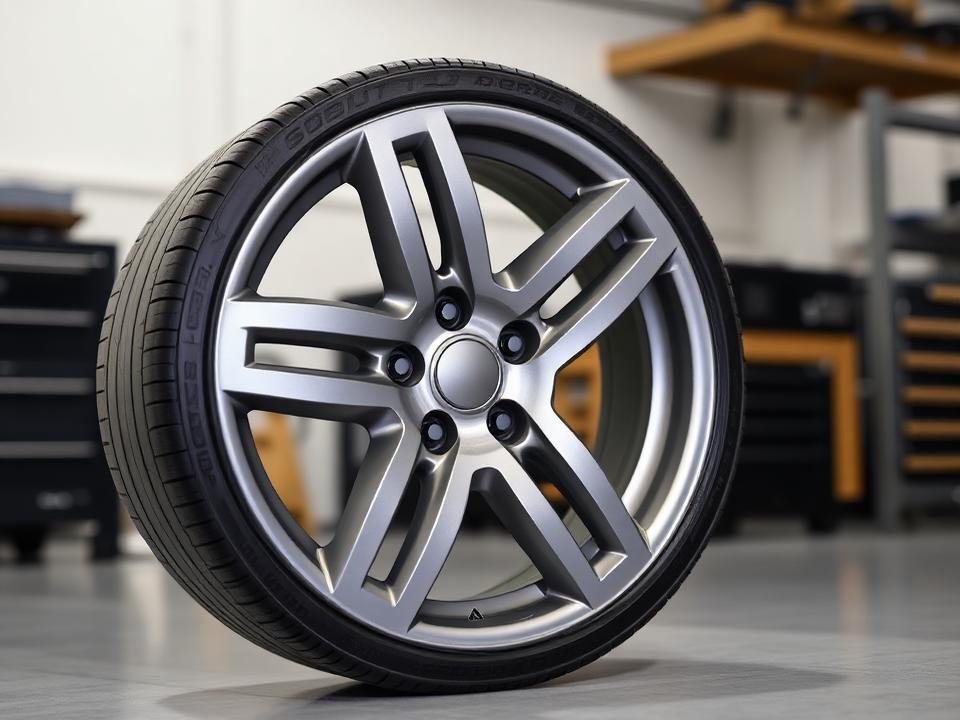
A buckled wheel is one that has been bent or deformed out of its true, round shape. This is almost always the result of a hard impact — most commonly a pothole strike, but sometimes a kerb impact taken at an awkward angle. Unlike a puncture, a buckle affects the metal wheel itself rather than the tyre, and it changes how the wheel runs even if the tyre holds air perfectly well.
The two technical terms that matter here are radial runout and lateral runout, and both describe the same basic idea in different directions. Radial runout is how much the wheel's rolling circle varies as it rotates — essentially whether the wheel is properly round or slightly egg-shaped after the impact. Lateral runout is how much the wheel wobbles side to side as it spins, like a plate that is not sitting flat. Either type of runout beyond a normal tolerance will cause the wheel to run unevenly, and both are measurable on a proper balancing and runout check.
In practical terms, a buckled wheel usually announces itself as a vibration felt through the steering wheel at certain speeds, sometimes changing character or intensity as speed increases. It is often a vibration that a standard wheel balance does not fully resolve. This is a key distinction: balancing corrects for uneven weight distribution around the wheel, while a buckle is a physical shape distortion, so no amount of balancing weight will fix a genuinely bent wheel. If a wheel keeps needing rebalancing or the vibration returns quickly, a buckle is worth checking for.
Buckled wheels can also cause slow air loss, particularly where the deformation affects the bead seat — the precise surface the tyre's edge seals against. Even a small distortion here can be enough to break that seal slightly and let air escape gradually. This is similar to how a crack can cause air loss, but through mechanical distortion rather than a break in the metal.
When customers come to us
- Vibration through the steering wheel
- A vibration that develops or worsens at certain speeds, often following a specific pothole or kerb impact, and frequently a sign of a buckled rather than simply unbalanced wheel.
- Vibration that returns quickly after balancing
- A wheel that has just been balanced but starts vibrating again within a short time, which points towards a shape distortion rather than a weight issue.
- Slow air loss after a pothole impact
- A tyre losing pressure gradually after hitting a pothole hard, potentially caused by the bead seat surface being distorted by a buckle.
- Visible wobble when the wheel spins
- A wheel that visibly wobbles from side to side when jacked up and spun by hand, which is a fairly direct sign of lateral runout.
- Uneven tyre wear developing
- Wear patterns on the tyre that develop unevenly, sometimes linked to a wheel that is not running true rather than a suspension or alignment issue alone.
- Concern after a specific hard impact
- No obvious vibration yet, but wanting the wheel checked proactively after hitting a significant pothole or kerb, since damage is not always immediately noticeable.