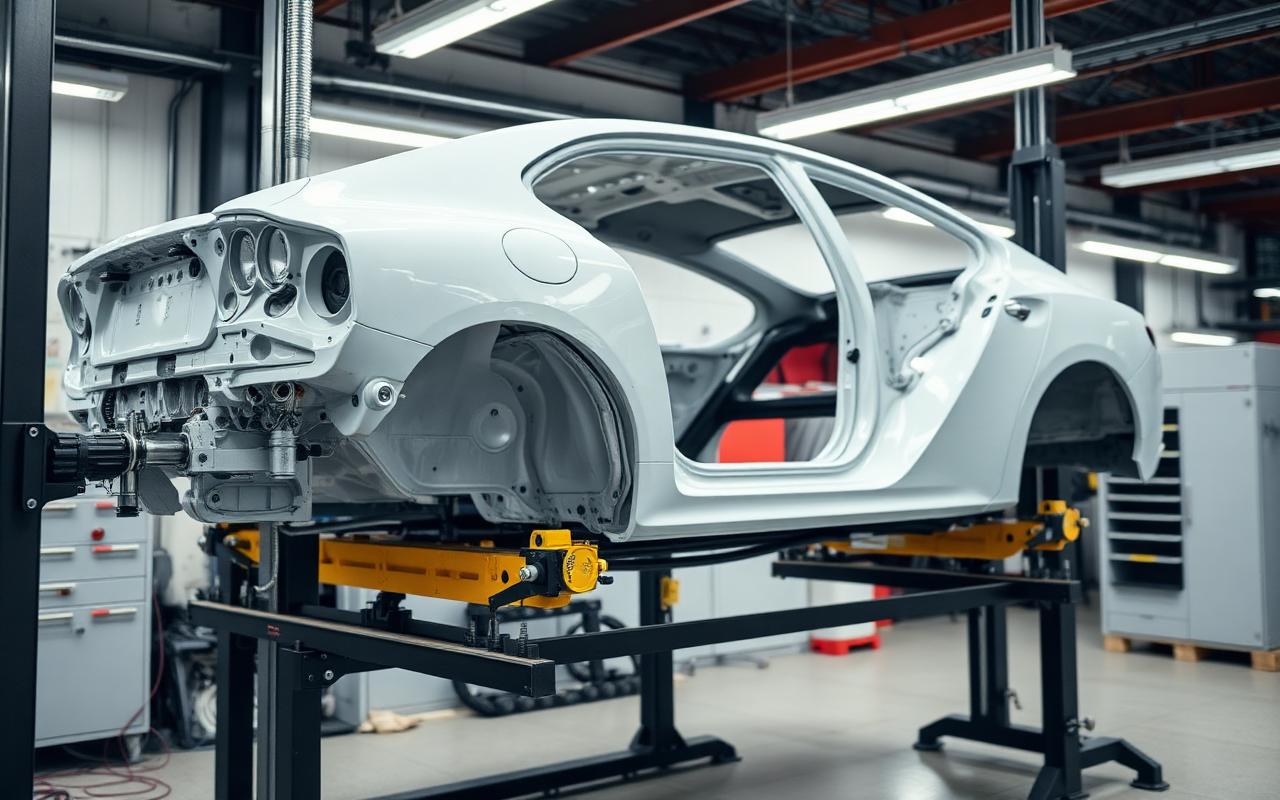
Structural damage means damage to the parts of a vehicle that are engineered to manage crash energy, hold the car's shape under load, and keep the passenger compartment intact in a collision. This includes the chassis rails, sills, floor structure, crumple zones, suspension mounting points and the pillars that support the roof. It's distinct from cosmetic panel damage — a dented door skin is inconvenient, but a bent chassis rail changes how the whole car behaves in a future impact. That's not something that can be judged by eye.
Modern vehicle structures are built from a mix of materials chosen for specific jobs: mild steel in some areas, and high-strength and ultra-high-strength steel in crumple zones and pillars where controlled deformation matters. Increasingly, aluminium is used in body structures where weight reduction is the priority. Electric vehicles add another layer of complexity, with structural elements built around integrated battery packs and, in some designs, the battery enclosure itself forming part of the structural load path. Each of these materials behaves differently under repair. High-strength steel can lose its designed properties if heated incorrectly during welding, and aluminium requires isolated tools and workspace to avoid galvanic contamination with steel. EV structures may also include specific handling and isolation requirements around the high-voltage system before any structural work near the battery area can even begin.
This is why repair information matters so much in structural work. Manufacturers publish repair methods for their specific vehicles — which sections can be cut and replaced, and which must never be repaired and instead require a new part. This also covers which fixings and adhesives are approved for a joint, and where welding is permitted versus where a bonded and riveted joint is required. Recognised manufacturer repair methods exist because vehicle manufacturers have crash-tested these repair approaches. Departing from them means departing from tested safety performance, which is why our repairs are carried out following that published information rather than general workshop convention.
Measuring is the part of structural repair that can't be skipped or approximated. A vehicle's chassis and body points are engineered to sit at specific measurements relative to each other, published by the manufacturer as datum points. After an impact, we use a computerised measuring system to check the vehicle's actual dimensions against those datum points before starting any repair. We continue measuring throughout the repair as the structure is pulled, straightened or replaced back toward its correct position, and again at the end to confirm the finished result is within tolerance. A car can look straight in a workshop and still be measurably out of alignment in ways that affect handling, tyre wear and, critically, how it would perform in a future collision.
When customers come to us
- Vehicle pulls to one side after a collision
- This is a classic sign of chassis or suspension mounting misalignment following an impact and needs measuring against manufacturer datum points, not just a wheel alignment check.
- Doors, bonnet or boot don't close or align properly
- Uneven panel gaps after an accident often point to a structural shift underneath the visible panels rather than a simple panel issue.
- Warning lights for ADAS or safety systems after an impact
- Camera and radar-based systems can be knocked out of calibration by structural movement even in a moderate impact, and need recalibrating as part of the repair.
- Insurer has flagged the vehicle for a structural assessment
- Insurers often refer vehicles with suspected chassis or structural damage for a full measuring and assessment before authorising repair.
- Visible chassis rail or sill damage
- Bent or crumpled structural rails need cutting, sectioning or full panel replacement to manufacturer specification, not just straightening.
- EV involved in a collision near the battery structure
- Any structural work near an EV's battery enclosure requires careful assessment and isolation procedures before repair can begin.