360 Alloys

Alloy Wheel Powder Coating

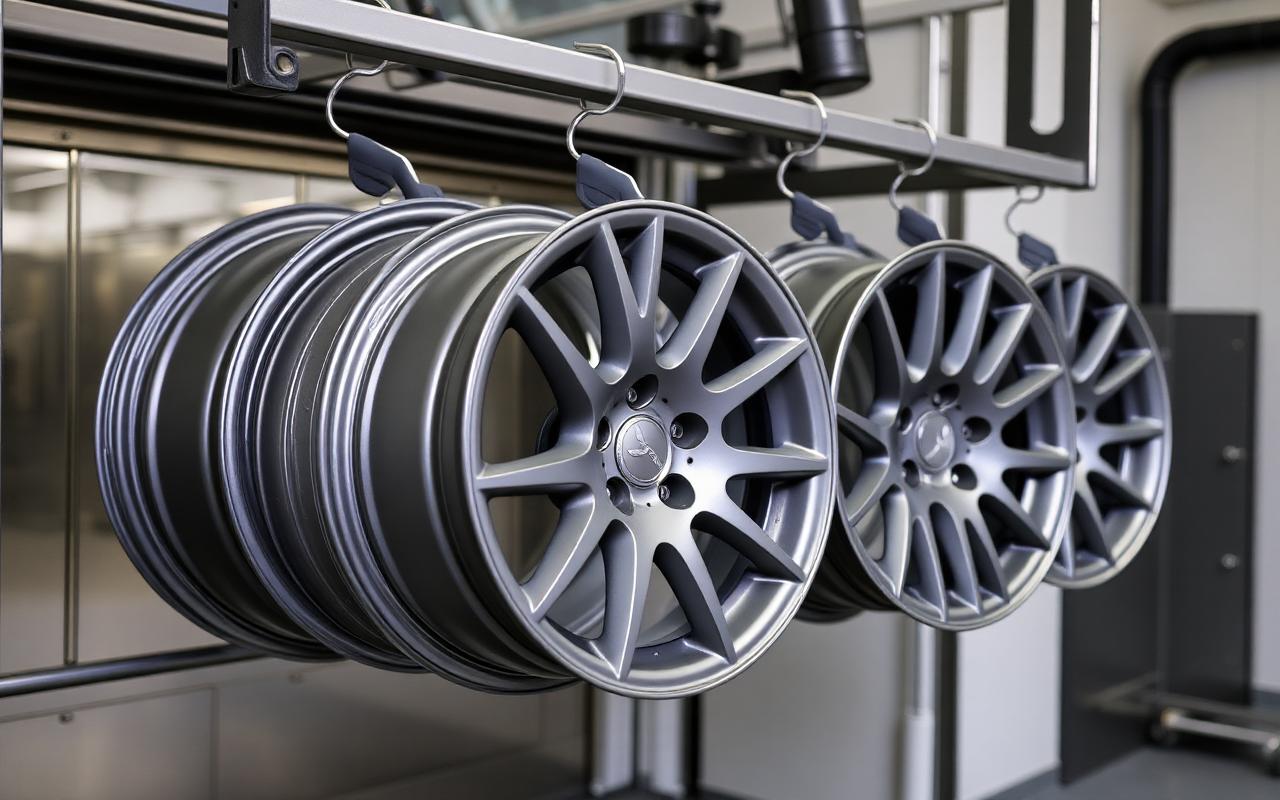
Powder coating applies a dry, electrostatically charged powder finish that is then cured under heat to form a hard, even, durable coating across the whole wheel. It stands up well to stone chips, wheel cleaners and general road use, and we complete every stage in-house.

Alloy wheel finished in a gloss powder coating on a workshop bench

About this service

Powder coating is fundamentally different from a standard painted finish, even though both can end up looking similar to the eye. Rather than being sprayed on as a wet liquid, the coating starts as a dry powder that is applied to the wheel using an electrostatic charge. This attracts the powder particles evenly across the whole surface, including into recesses that a wet spray can sometimes miss. The wheel is then baked in an oven, where the powder melts and fuses into a single continuous layer.

That curing process is what gives powder coating its durability. Because the coating flows and bonds as one solid layer rather than drying from multiple separate wet coats, it tends to be more resistant to chipping, fading and general wear. This is compared with a simple painted finish of comparable colour. It is a genuinely sensible choice for wheels that take a lot of road abuse, or for anyone who wants a long-lasting finish without the ongoing maintenance a bare diamond-cut face requires.

Before any powder is applied, the wheel goes through the same stripping and preparation process as any other refinishing job. Old paint, lacquer and any corrosion are removed back to sound bare alloy. Powder coating applied over a poorly prepared surface will fail at the same weak points a paint job would — the coating is only as good as the surface underneath it. Corrosion in particular needs to be fully treated before coating, since sealing corrosion under a fresh coating does not stop it continuing to spread beneath the surface.

We offer gloss, satin and matt finishes across a wide range of colours, and can discuss OEM-style shades as well as custom colours. Gloss gives the shiniest, most reflective finish and is the closest match to most factory colours. Satin sits between gloss and matt with a soft sheen. Matt gives a completely flat, non-reflective finish that has become popular on modern performance and SUV-style wheels. All three are applied and cured using the same underlying process, with the finish sheen determined by the powder used.

When customers come to us

Wanting a harder-wearing finish than paint
Owners whose wheels have chipped or worn quickly with a previous painted finish and want a more durable coating this time.
Matt or satin finish requests
A desire for a flat matt or soft satin look that a standard gloss paint job cannot achieve without a different coating system.
Colour change across a full set
Wanting all four wheels finished in a new colour with a consistent, even sheen across the set.
Corrosion needing a durable rebuild
Wheels where corrosion has been treated and now need a coating that will resist moisture better than the finish that failed previously.
Wheels that see heavy daily wear
Daily-driven cars where the wheels are regularly exposed to stone chips, road salt and frequent washing, and need a finish built to cope with that.
Dissatisfaction with a previous basic paint job
A prior repair that only addressed the visible face without proper stripping or preparation, and has already started to look patchy or worn.
What the work includes

  • Wheel stripping back to bare alloy
  • Corrosion assessment and treatment
  • Surface preparation and cleaning
  • Masking of areas not to be coated
  • Electrostatic powder application
  • Oven curing to fuse the coating
  • Choice of gloss, satin or matt finish
  • Colour matching discussion, including OEM-style shades
  • Quality check for even coverage and consistent sheen
  • Final inspection before refitting

How it works

The 360 process for powder coating

  1. 01

    Stripping

    The wheel is stripped of its existing paint, lacquer and any old coating back to bare alloy, so the new powder coat is bonding to sound metal rather than sitting over a compromised surface.

  2. 02

    Preparation and corrosion treatment

    Any corrosion is treated back to sound alloy, and the surface is cleaned and prepared to give the powder coating the best possible surface to bond to.

  3. 03

    Powder application

    Powder is applied using an electrostatic process that draws it evenly across the wheel's surface, including recesses and spoke edges that a wet spray can sometimes leave thin.

  4. 04

    Curing

    The wheel is baked at a controlled temperature so the powder melts and fuses into a single continuous coating, which is what gives powder coating its durability compared with wet paint.

  5. 05

    Finish and quality check

    Once cooled, the wheel is checked for even coverage, correct sheen level and consistent colour, particularly important where a full set is being finished together.

Capability

Why powder coating lasts the way it does

The electrostatic application stage is central to why powder coating is so even. Powder particles carry an electrical charge as they are applied, and the wheel is earthed. This means the charged particles are drawn onto the metal surface uniformly, rather than relying purely on spray direction and pressure the way wet paint does.

Curing at high temperature causes the powder to melt and flow together into a single film, chemically cross-linking as it cools. This is fundamentally different to a wet paint system, which dries through solvent evaporation across multiple thinner coats. The fused nature of a cured powder coat is generally what gives it better resistance to chipping and abrasion.

None of this durability matters if the surface underneath is not properly prepared, which is why stripping and corrosion treatment happen before any powder goes on. Coating over corrosion or residual old paint traps the problem underneath a durable shell, and the coating will eventually fail at that weak point regardless of how well it was applied on top.

Gloss, satin and matt are achieved through different powder formulations rather than different application techniques, so the choice of sheen does not affect the coating's underlying durability — it is purely a visual preference.

  • Electrostatic application gives even coverage into recesses and edges
  • Oven curing fuses the coating into one continuous layer rather than multiple wet coats
  • Durability depends on proper stripping and corrosion treatment beforehand, not just the coating itself
  • Gloss, satin and matt are different formulations with the same underlying process

Care and limitations

Powder coating is a durable cosmetic and protective finish, but it is not indestructible. Heavy kerb impacts can still chip or crack the coating, and it does not correct structural damage such as cracks or buckling. That damage needs separate assessment and repair before or instead of coating.

Why 360

Why customers choose us for this work

Full strip before every coating job
We never coat over an existing finish or unresolved corrosion, ensuring the new coating bonds to a properly prepared surface.
Gloss, satin and matt available
A genuine range of finish options rather than a single default gloss look.
Consistent finish across a full set
Wheels done together are processed to match sheen and colour as closely as possible across all four.
Completed in-house
All stripping, preparation and coating happens at Loverock Road, with our own oven-curing process.

Warranty

Powder-coated alloy wheel work carries a twelve-month warranty, subject to terms confirmed at booking.

Reading facility

Loverock Road, Reading

  • 360 Garage
  • 360 Alloys

Garage, MOT, diagnostics, mechanical repairs, performance and alloy-wheel refurbishment.

119 Unit 4 Loverock Road, Reading, RG30 1DZ
0118 394 3000

Monday – Friday: 9:00am – 6:00pm

Saturday: By appointment only

Sunday: By appointment only

Questions

Powder Coating — frequently asked

360 Alloys

Request an Alloy Quote

Complete wheel refurbishment, diamond cutting and structural alloy repair.

Add photos if they help us understand the work. This is optional.

We’ll use these details only to respond to your enquiry and manage any work you ask us to complete. View our Privacy Policy.